How to Monitor Emerging Scam Trends in Your Region With Global Fraud Index
In the digital age, the speed of deception is staggering. By the time a new fraud tactic reaches the evening news or a government circular, the “early adopters” of that scam have already moved on to their next target. For cybersecurity professionals, compliance officers, and even vigilant consumers, the challenge isn’t just knowing that scams exist—it’s knowing which ones are gaining momentum right now.
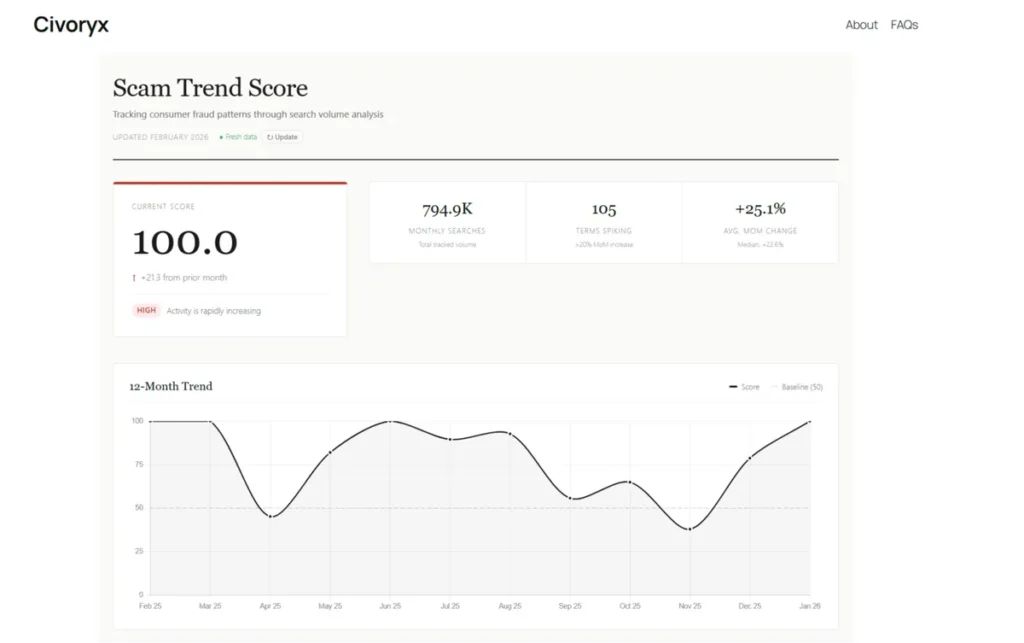
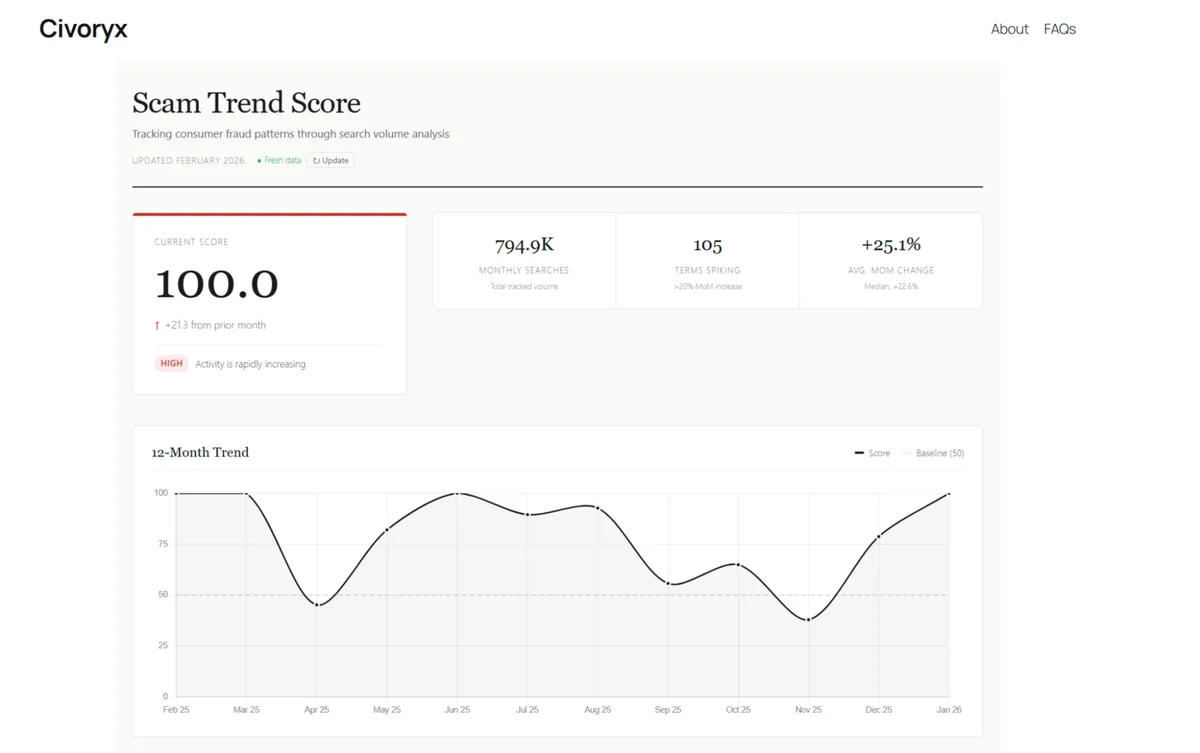
Enter Civoryx, the Global Fraud Index. Civoryx provides a real-time, data-driven lens into the world of fraud by tracking what people are searching for. Instead of relying on anecdotal evidence or lagging police reports, Civoryx aggregates search volume data across 150+ fraud-related keywords to produce the Scam Trend Score.
This guide will walk you through how to use Civoryx to monitor emerging scams, interpret its unique data signals, and apply those insights to protect your organization or community.
What is Civoryx? The “Global Fraud Index” Explained
Civoryx is a free, public utility designed to bring transparency to the fraud landscape. It operates on a simple but powerful premise: When people encounter a scam, they search for answers. By monitoring the velocity of these searches, Civoryx can identify a “hot” scam before it becomes a household name. The platform is built on three core pillars:
- Monitor: Continuous tracking of 150+ keywords spanning identity theft, crypto scams, romance fraud, and phishing.
- Measure: Calculation of month-over-month (MoM) change, weighted by absolute search volume.
- Score: The aggregation of these changes into a single metric—the Scam Trend Score.
The Anatomy of the Scam Trend Score
The score operates on a scale of 0 to 100.
- 50: Indicates stable fraud activity.
- Above 50: Suggests increasing consumer interest and accelerating fraud threats.
- Below 50: Indicates that fraud-related search interest is cooling off.
A unique technical aspect of the Civoryx methodology is its commitment to accuracy through constant adjustment. Civoryx recalibrates its keyword weighting model every 90 days. This ensures that as language evolves—for example, as “phishing” gives way to more specific terms like “smishing” or brand-specific alerts—the index remains a precise reflection of current reality.
Step 1: Navigating the Civoryx Dashboard
When you arrive at the Civoryx index, you are met with “No opinions. No speculation. Just data.” Because the platform is fully public and requires no account or paywall, you can begin your analysis immediately.
Understanding the Methodology
Before diving into the numbers, it’s helpful to understand how the data is handled:
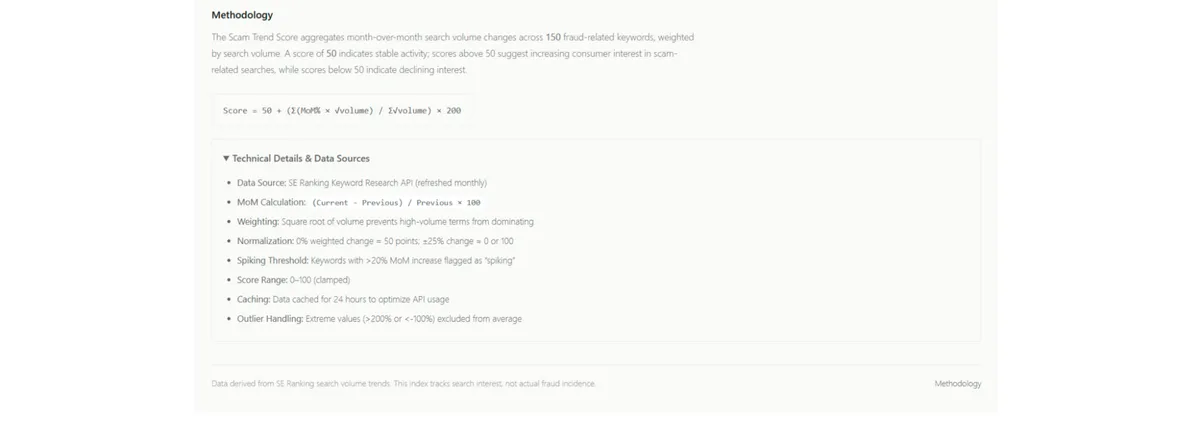
- Data Source: Information is pulled from the SE Ranking Keyword Research API and refreshed monthly.
- Weighting: Civoryx uses the square root of volume for weighting. This prevents massive generic terms (like “scam”) from completely drowning out significant spikes in niche, high-intent terms (like “EZ Pass scam”).
- Outlier Handling: If a keyword grows by 5,000%, Civoryx tags it but excludes extreme statistical outliers (>200% or <-100%) from the general average calculation to keep the core score from being skewed by “noise.”
Step 2: Identifying “Spiking” Scams
The most critical feature for early detection is the Spiking Threshold. Civoryx flags any keyword with a greater than 20% MoM increase as “spiking.”
February 2026 Case Study: The SMS Shift
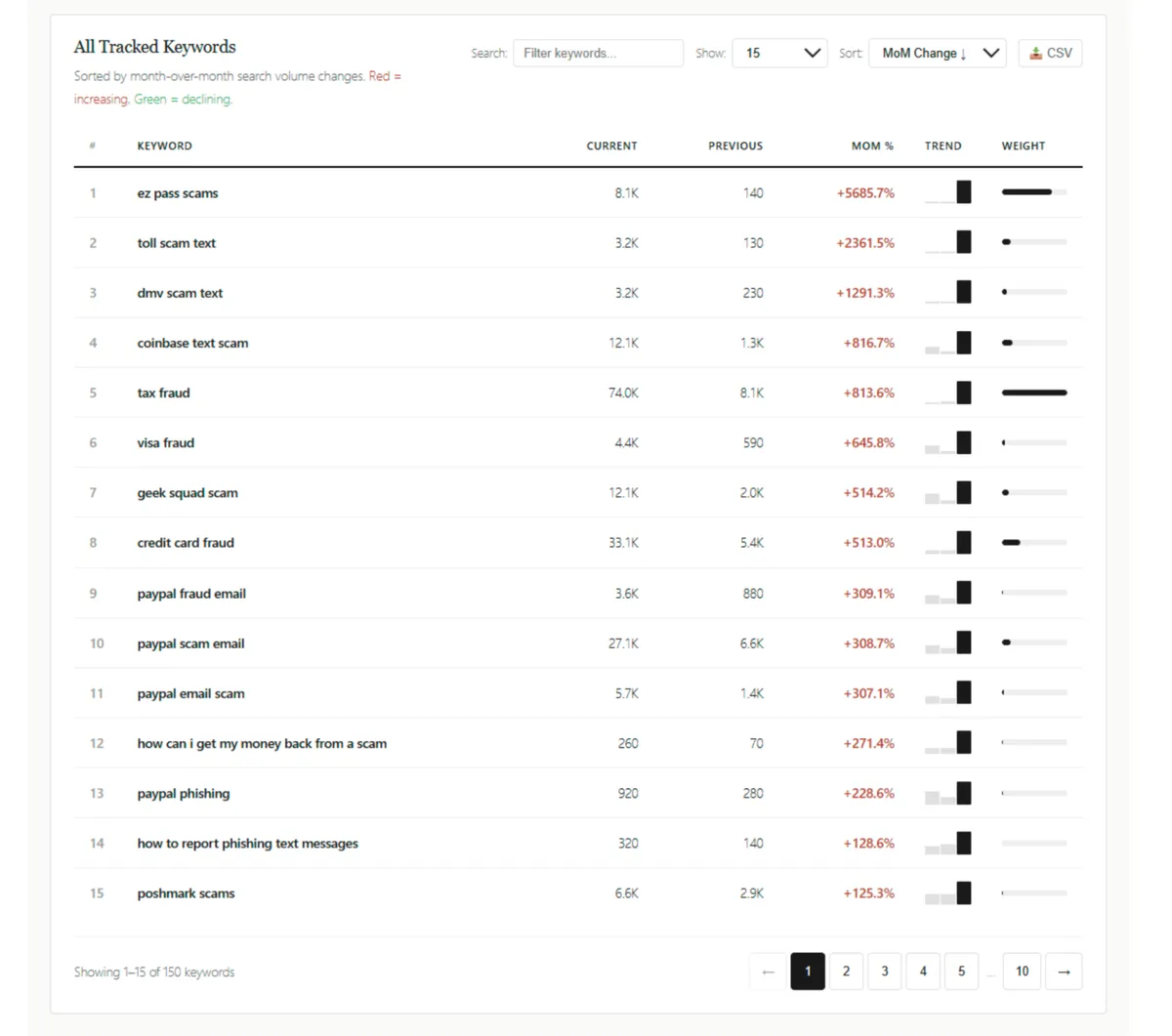
Looking at the most recent February 2026 data, we can see a massive shift toward infrastructure-related impersonation. The fastest-growing themes include:
| Scam Theme | MoM Growth |
| EZ Pass Scams | +5,685% |
| Toll Scam Text | +2,361% |
| DMV Scam Text | +1,291% |
| Coinbase Text Scam | +817% |
The Insight: When you see growth percentages in the thousands, you are looking at a coordinated “blitz” campaign. The February data reveals a clear channel shift toward SMS-driven impersonation. If you are a business owner or a security head, this is your signal to warn your stakeholders specifically about text-based threats rather than generic email phishing.
Step 3: Analyzing Total Impact (Weighted Contribution)
Growth percentage tells you how fast a scam is moving, but Weighted Contribution tells you how much “space” it occupies in the current fraud landscape. A scam might grow by 1,000%, but if only 10 people are searching for it, the total risk is low.
According to the latest Civoryx data, the top contributors to the current Scam Trend Score are:
- Tax Fraud (75.74 contribution): This is the largest driver by far.
- EZ Pass Scams (57.94 contribution): High growth paired with high volume makes this a massive threat.
- Credit Card Fraud (21.36 contribution): A perennial threat that remains a heavy hitter.
Why Contribution Matters
By looking at the contribution, you can prioritize your resources. While “DMV scam texts” are growing fast (+1,291%), “Tax fraud” has a much higher contribution (75.74 vs 5.20). This suggests that while SMS scams are a trending method, the seasonal incentive—tax season—is currently the dominant narrative driving fraud activity globally.
Step 4: Spotting “Narrative-Driven” Fraud Cycles
One of the most nuanced ways to use Civoryx is to look at Declining Attention. Sometimes, what people aren’t searching for is just as telling as what they are.
In the current dataset, generic queries are falling:
- “Is this a scam”: -55%
- “Phishing”: -18%
- “Gift card scam”: -46%
The Analysis: When specific scam types (like EZ Pass or Coinbase) spike while generic awareness terms (like “is this a scam”) fall, it signals a Narrative-Driven Fraud Cycle.
This means attackers are successfully using highly specific, believable stories that don’t immediately “feel” like scams to the average person. Victims aren’t searching for “is this a scam”; they are searching for “how to pay my DMV fine” or “EZ Pass payment failed.” As a monitor, this tells you that your education efforts need to move away from “how to spot a scam” and toward “how the DMV actually communicates with you.”
Step 5: Applying Civoryx Data to Your Region
While the Scam Trend Score is a global composite, the keyword sets often have regional implications. Most infrastructure scams (DMV, EZ Pass, Tolls) are highly localized to specific countries or states.
For Compliance & Risk Teams
If you are managing a financial institution or a fintech startup, use the Civoryx breakdown to update your Transaction Monitoring Rules.
- If Tax Fraud is spiking: Increase monitoring for unusual transfers to or from government-lookalike accounts.
- If Crypto Scams (e.g., Coinbase text scam) are spiking: Implement a “cooling-off” period or additional 2FA prompts for customers attempting to transfer funds to crypto exchanges.
For Cybersecurity Researchers
Use the Category Structure of the Signal to write your threat briefings. The February profile shows:
- Tax-related fraud: ~75.7 contribution
- Payments & Financial: ~56 contribution
- Messaging Vectors (SMS/Email): ~15.6 contribution
This allows you to tell your board or your clients: “Our primary risk right now isn’t generic phishing; it is specifically SMS-delivered financial impersonation centered around the tax season and transit tolls.”
Summary of the Civoryx Advantage
Civoryx serves as a leading context indicator. It doesn’t tell you how many people were successfully defrauded (that’s a lagging indicator found in police reports); it tells you what the world is worried about right now.
By monitoring the index, you gain:
- Early Warning: Identify spikes like the +5,685% increase in EZ Pass scams before they hit your local news.
- Prioritization: Use weighted contribution to decide which threats deserve your immediate attention.
- Strategic Precision: Understand the “narrative” of the fraud cycle—whether it’s seasonal (tax) or channel-specific (SMS).
A Note on Integrity
Because Civoryx is free and permanently public, there is no barrier to entry. Civoryx believes that fraud transparency shouldn’t have a price tag. The data is open because the problem of fraud is universal.
By checking the Scam Trend Score regularly, you move from a reactive posture to a proactive one. You aren’t just waiting for the next headline; you are watching the data move in real-time.
Frequently Asked Questions (FAQ)
What exactly does the Scam Trend Score measure?
The Scam Trend Score is a composite, data-driven metric that reflects the velocity of public attention toward specific fraud types. It is not a count of confirmed police reports or financial losses, which are “lagging” indicators that can take months to compile. Instead, it measures search engine intent in real-time. When a score rises above 50, it indicates that more people are searching for terms associated with scams, suggesting a surge in active fraudulent campaigns.
How does Civoryx ensure the data isn’t skewed by high-volume searches?
Civoryx uses a specific mathematical weighting system to maintain the integrity of the signal. If Civoryx tracked raw volume alone, a generic term like “credit card” would always drown out a specific, high-risk term like “toll scam text.” To prevent this, Civoryx recalibrates its keyword weighting model every 90 days. This allows us to adjust for linguistic shifts and ensure that spiking “niche” scams—which often represent the most immediate threats—carry enough weight to influence the overall score. Additionally, Civoryx uses the square root of search volume to normalize data and prevent “monopoly” terms from distorting the index.
Why is Civoryx free to the public?
Civoryx believes that transparency is the most effective weapon against fraud. Fraudsters profit from information asymmetry—they know the play, and the victim doesn’t. By keeping the Global Fraud Index free, public, and ungated, Civoryx provides researchers, journalists, and consumers with the same high-level data tools used by enterprise compliance teams. There are no “premium” tiers because the mission is universal: to surface fraud shifts early enough to prevent them.
Where does the data come from?
The primary data source is the SE Ranking Keyword Research API, which provides comprehensive search volume metrics. Civoryx monitors a curated index of over 150 keywords that are refreshed and analyzed monthly. To ensure accuracy and performance, data is cached for 24 hours, providing a stable yet highly responsive view of global trends.
Can I use Civoryx data for my own reporting or business risk assessments?
Yes. Civoryx is designed to be a “leading context indicator.” For businesses, it serves as a foundation for short-term threat briefings, customer warning campaigns, and the prioritization of transaction monitoring rules. For individuals, it provides a “weather report” for the digital world, letting you know when it is time to be extra vigilant about specific channels, such as SMS or tax-related communications.