Civoryx Review: Is Search Volume a Reliable Proxy for Fraud Activity?
Fraud is a shape-shifter. By the time a new scam typology is officially classified, reported by victims, aggregated by law enforcement agencies, and broadcasted by mainstream media, the threat actors have already moved on to their next campaign. This structural lag in threat intelligence leaves consumers vulnerable and forces compliance and cybersecurity teams into a perpetually reactive posture.
Enter Civoryx, the self-proclaimed Global Fraud Index. Civoryx operates on a seemingly simple but highly compelling premise: before victims report a scam, they search for it. By tracking the velocity and volume of specific fraud-related queries across global search engines, Civoryx attempts to map the shifting attention of cybercriminals and their targets in real time.
This review will dissect the mechanics of Civoryx, analyze its February 2026 dataset, and answer the critical underlying question: Is search volume actually a reliable proxy for global fraud activity?
The Core Philosophy: Behavior Before Reporting
Historically, fraud intelligence has relied on post-incident reporting. Organizations like the Federal Trade Commission (FTC) in the United States or Action Fraud in the UK compile extensive, highly accurate databases of scam activity. However, these databases suffer from an inherent reporting delay. A victim must realize they have been defrauded, navigate the bureaucratic process of reporting it, and wait for the agency to publish its quarterly or annual findings.
Civoryx bypasses this delay by analyzing human behavior at the moment of suspicion. When someone receives an alarming text message about an unpaid toll, or a suspicious email allegedly from PayPal, their first instinct is rarely to call the police; their first instinct is to type the contents of that message into a search engine.
Civoryx is built to capture that exact moment of uncertainty, arguing that a massive, coordinated spike in specific search terms is the most immediate indicator of an active fraud campaign. No opinions. No speculation. Just raw, behavioral data.
Anatomy of the Index: How Civoryx Works
Civoryx is structured around a three-layer methodology—Monitor, Measure, and Score—designed to filter out the noise of the internet and isolate clear signals of malicious activity.
1. Monitor: The Curated Index
Civoryx continuously tracks the search volume for a highly curated index of over 150 fraud-related keywords. This list is not static; it spans established categories like phishing, identity theft, crypto scams, and romance fraud, while also monitoring hyper-specific long-tail queries.
2. Measure: Velocity and Volume Weighting
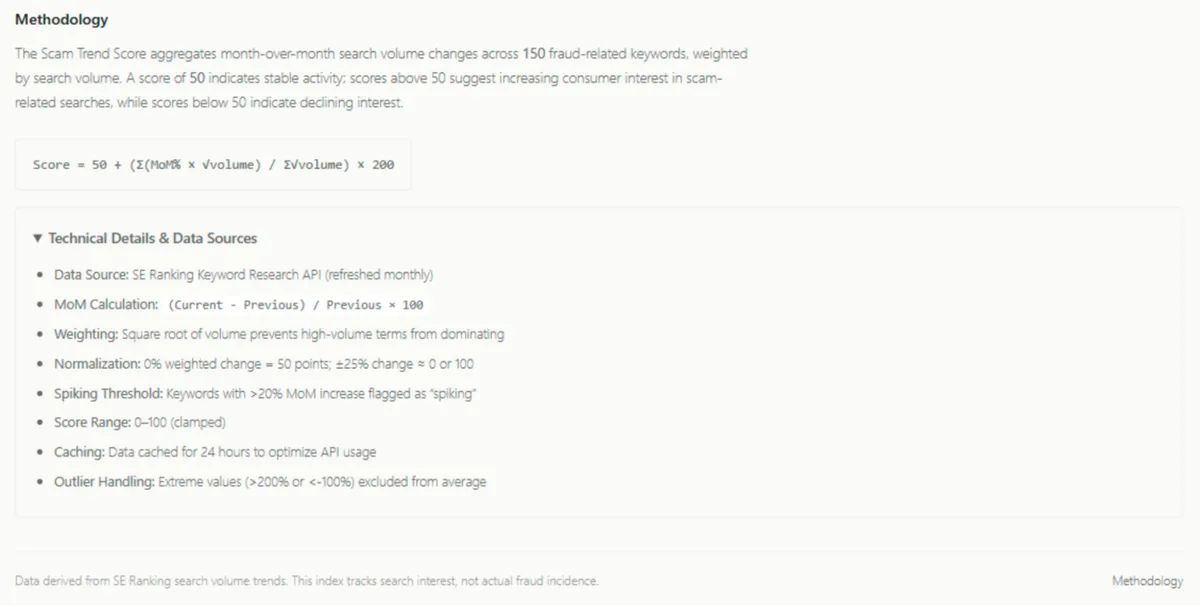
The true value of a data index lies in how it handles outliers and baseline noise. Civoryx does not simply look at percentage growth. It calculates the month-over-month (MoM) change for each keyword and weights that change by its absolute search volume.
A 500% spike in a niche term with 10 monthly searches is statistical noise. A 50% spike in a term with 1,000,000 monthly searches is a global event. By weighting by absolute volume, high-volume keywords that spike carry significantly more signal in the index.
To ensure the index remains reflective of current human behavior and search engine algorithms, Civoryx recalibrates its keyword weighting model every 90 days. This crucial, often overlooked feature prevents the index from becoming stagnant. As colloquial language evolves—for instance, users shifting from searching “crypto fraud” to “web3 wallet drainer”—the 90-day recalibration ensures the mathematical model accurately reflects these shifting linguistic trends, maintaining the score’s accuracy.
3. Score: The Scam Trend Score
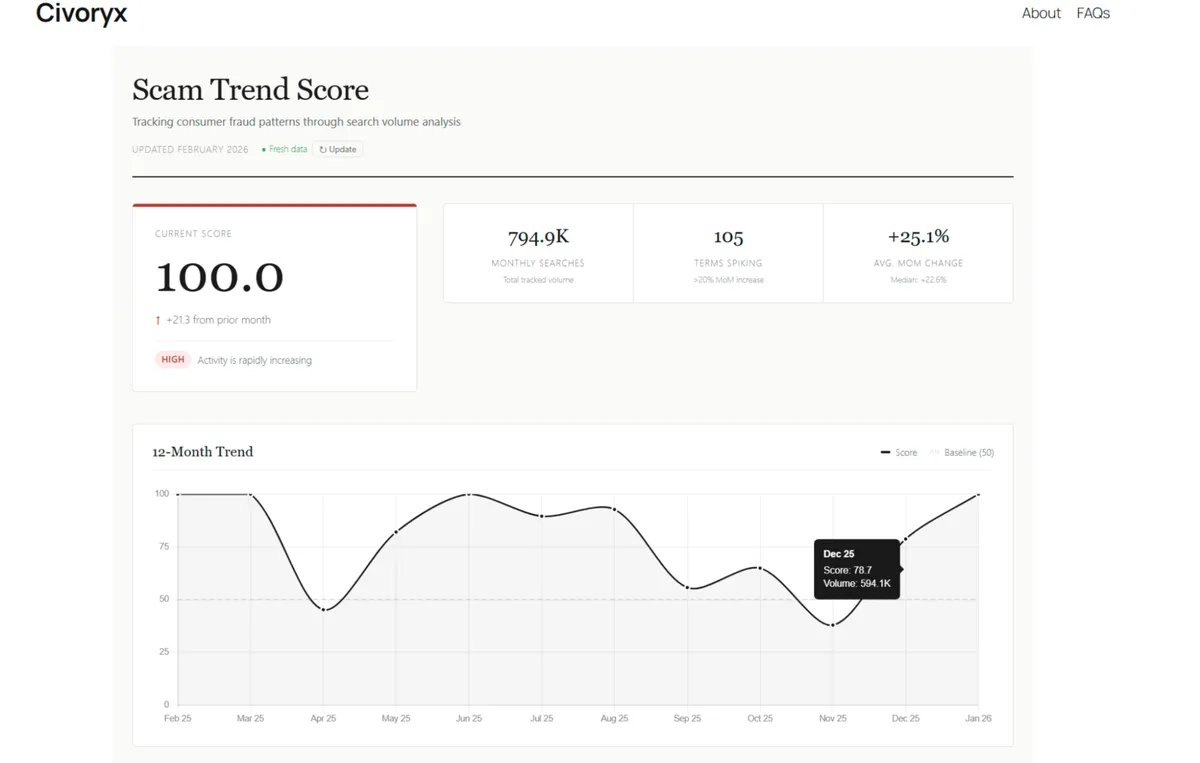
The weighted changes are aggregated into a single composite metric known as the Scam Trend Score.
A rising score indicates that fraud-related search interest is accelerating globally, suggesting active, widespread campaigns. A falling score means the search interest is cooling, indicating either a lull in attacker activity or the successful mitigation of a recent campaign.
Deep Dive: Analyzing the February 2026 Dataset
To evaluate Civoryx’s utility, we must look at what its data is currently telling us. The February 2026 dataset provides a stark, highly concentrated picture of the global fraud landscape.
The Dominance of Seasonal and Infrastructure Scams
The index currently shows a massive concentration of signal driven by a small cluster of themes. The top contributors to the Scam Trend Score (representing the largest weighted impact) are:
- tax fraud — 75.74
- ez pass scams — 57.94
- credit card fraud — 21.36
- coinbase text scam — 12.43
- paypal scam email — 10.53
- toll scam text — 9.51
- geek squad scam — 7.83
- dmv scam text — 5.20
- visa fraud — 3.57
- paypal email scam — 2.20
Tax-Related Fraud: Grouping keywords by intent reveals that tax-related fraud is the single largest driver of the index, holding an approximate 75.7 contribution score. Given that February sits squarely in the lead-up to the traditional tax season in the United States and several other nations, this data perfectly mirrors real-world seasonality. Threat actors know that anxiety around government compliance is high, making citizens prime targets for impersonation.
Payments & Financial Scams: This category holds an approximate contribution score of 56, spread across card and wallet fraud. The presence of Coinbase, PayPal, and Visa highlights that direct financial extraction remains the primary goal, but the delivery mechanisms are shifting.
The Rise of “Smishing” (SMS Phishing)
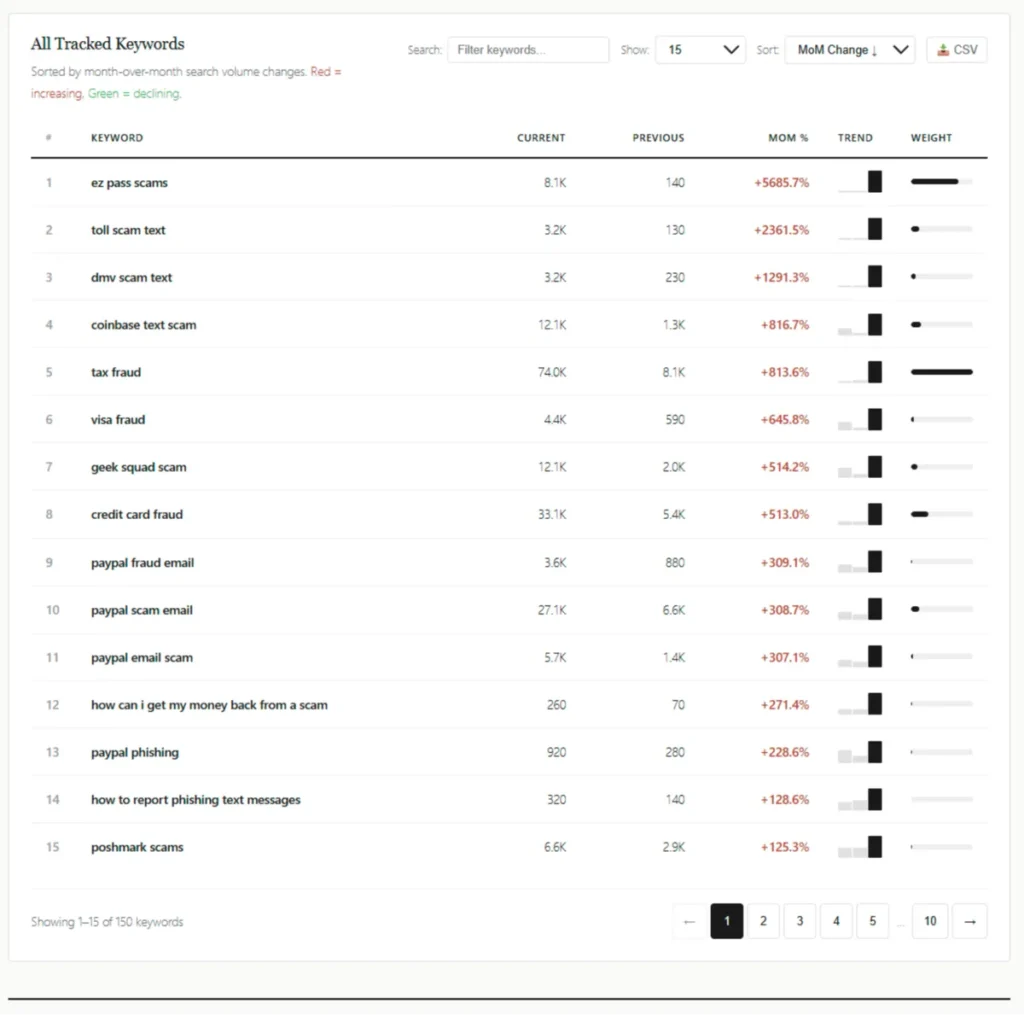
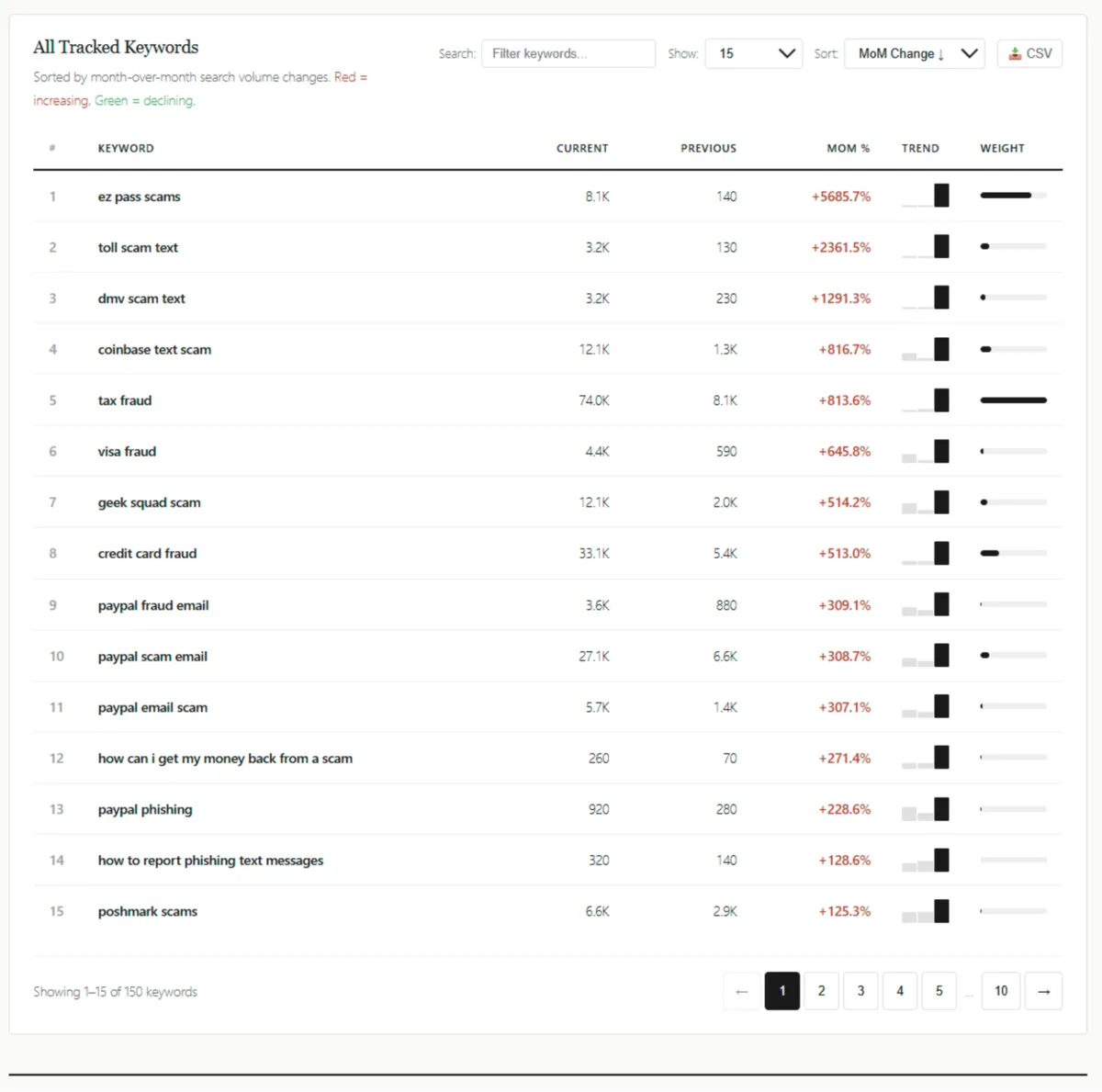
Perhaps the most alarming and actionable insight from the February 2026 data is the fastest-growing scam themes by percentage. The dataset shows unusually sharp month-over-month growth in infrastructure and payment-related scams delivered via mobile devices:
- ez pass scams — +5,685%
- toll scam text — +2,361%
- dmv scam text — +1,291%
- coinbase text scam — +817%
- tax fraud — +814%
- visa fraud — +646%
- geek squad scam — +514%
- credit card fraud — +513%
The staggering 5,685% increase in “ez pass scams” and the 2,361% increase in “toll scam text” point to a highly coordinated, massive-scale channel shift toward SMS-driven impersonation.
Why this shift? As email providers (like Gmail and Outlook) implement increasingly aggressive, AI-driven spam filters, threat actors are migrating to SMS, where carrier-level filtering is historically weaker, and open rates are significantly higher. The Civoryx data is effectively screaming that compliance teams, telecom providers, and banks need to immediately reassess their customer-communication controls and alerting thresholds regarding SMS links.
The Decline of Generic Queries
Just as important as what is rising is what is falling. Searches for broader, educational, or generic queries saw notable declines:
- is this a scam — -55%
- gift card scam — -46%
- mcafee scam — -45%
- brushing scam — -19%
- phishing — -18%
A 55% drop in “is this a scam” paired with a 5,685% rise in “ez pass scams” suggests that consumers are no longer dealing with vague, confusing anomalies. They are being targeted by highly specific, branded campaigns. They aren’t asking “is this a scam?”; they are asking “is this EZ Pass text a scam?” This specificity in search behavior is a goldmine for threat intelligence.
The Core Question: Is Search Volume a Reliable Proxy?
With the methodology and data laid out, we must return to the central thesis: Can we trust search volume as a proxy for actual fraud?
The Arguments in Favor
So, here these arguments are.
1. Unmatched Speed
The primary advantage of Civoryx is its zero-day visibility. Search volume spikes within hours of a massive phishing campaign being launched. By the time a bank notices a spike in fraudulent chargebacks related to a fake toll website, the Civoryx Scam Trend Score has already been elevated for days. This gives defenders a vital head start.
2. Uncensored Human Truth
People lie on surveys. They feel embarrassed to report scams to the police. But they do not lie to search engines. Search queries represent pure, unfiltered human anxiety and curiosity. When someone receives a terrifying text threatening a DMV license suspension, their search query is an immediate, honest reaction to a stimulus. Aggregating these reactions provides a highly accurate map of where threat actors are applying pressure.
3. Contextual Granularity
Because the index tracks specific branded keywords (like “coinbase text scam” vs “paypal scam email”), it doesn’t just tell researchers that fraud is happening; it tells them who is being spoofed and how the attack is being delivered.
Limitations and Risks
However, relying strictly on search volume is not without its caveats.
1. The “News Cycle” Echo Chamber
One major risk of using search volume as a proxy is the influence of mainstream media. If a major news outlet publishes a prime-time exposé on “brushing scams,” search volume for that term will inevitably spike the next day. This spike does not necessarily mean the scam itself has increased in frequency; it simply means public awareness has increased.
Civoryx attempts to mitigate this by tracking month-over-month velocity and weighting by absolute volume, but distinguishing between a “victim-driven search” and a “curiosity-driven search” remains an inherent challenge in any search-based index.
2. The Keyword Limitation
Threat actors are linguistically agile. If they launch a campaign so entirely novel that victims don’t know the right vocabulary to search for it, the index might miss it initially. While Civoryx’s 90-day recalibration model helps correct this over time, there is a theoretical blind spot for entirely unprecedented fraud typologies that defy standard search nomenclature.
3. False Positives from Legitimate Errors
A legitimate technical outage at a major institution can sometimes mirror the search patterns of a scam. If a payment gateway goes down and users receive erroneous error messages, they might search “Gateway X fraud?” out of suspicion. While the score is a powerful indicator, it must be cross-referenced with operational intelligence.
Who Benefits from Civoryx?
Civoryx states that it is for “Anyone who needs to understand the fraud landscape.” In practice, the utility of this data scales differently depending on the user:
- Fraud & Compliance Teams: For anti-money laundering (AML) and fraud prevention professionals at financial institutions, Civoryx is a leading indicator. If the index shows a 1,200% spike in DMV SMS scams, a bank can preemptively adjust its rule engines, alert its call center staff, and push push-notifications to its banking app warning users of the specific threat.
- Cybersecurity & Threat Intel: Security researchers can use the specific keywords driving the Scam Trend Score to guide their honeypots and threat hunting. If “geek squad scam” is surging, researchers know to focus on reverse-engineering the latest Remote Access Trojan (RAT) payloads typically associated with fake tech support call centers.
- Journalists and Researchers: The platform provides instant, data-backed evidence of shifting trends, allowing investigative journalists to write timely warnings for the public rather than waiting for annual government reports.
- Consumers: Everyday users can check the index to validate their suspicions. Seeing that “toll scam text” is the fastest-growing threat globally provides immediate reassurance to a consumer who just received a suspicious SMS, confirming it is part of a wider campaign and not a legitimate bill.
Our in-depth analysis of the Global Fraud Index and the efficacy of search-based threat intelligence proves all that.
Pricing: The Democratization of Threat Intel
One of the most radical aspects of Civoryx is its business model—or lack thereof:
- Cost: $0
- Features: Public Access, Scam Trend Score, 150 keyword index, Month-over-month trend data.
- Gating: No account required, no paywall, no premium tiers.
In an industry where enterprise threat intelligence feeds can cost hundreds of thousands of dollars annually, providing this level of aggregated behavioral data for free is highly disruptive. Civoryx operates on the philosophy that “fraud transparency shouldn’t have a price tag.” By keeping the data open, they ensure that small credit unions, local journalists, and individual consumers have access to the same macro-level early warning signals as massive multinational banks.
Final Verdict: A Vital Piece of the Puzzle
Is search volume a reliable proxy for fraud activity? Yes, with necessary contextual caveats.
Civoryx is not a replacement for deterministic, post-incident fraud data. It will never tell you exactly how many dollars were lost in a specific campaign, nor will it identify the exact criminal syndicate behind it.
However, as an early warning system, it is arguably one of the most elegant and responsive tools currently available. By weaponizing search data—transforming the collective anxiety of millions of internet users into a single, quantifiable Scam Trend Score—Civoryx has created a real-time radar for the fraud industry.
The February 2026 data alone proves its worth. By clearly highlighting the massive, immediate pivot toward SMS-based infrastructure scams (like EZ Pass and DMV texts) and mapping the seasonal surge in tax fraud, Civoryx provides actionable intelligence that can save organizations and consumers millions of dollars if acted upon swiftly.
In a landscape where fraud evolves faster than headlines can follow, a 90-day recalibrated, volume-weighted index of human behavior isn’t just a “nice-to-have” metric; it is an essential layer of modern threat intelligence. And at a price point of zero, there is absolutely no reason for risk professionals not to integrate the Scam Trend Score into their daily operations.
FAQ
What is Civoryx?
Civoryx is the Global Fraud Index. It is a public, data-driven platform that tracks how fraud attention shifts across the internet in real time. By monitoring what people are searching for when they suspect a scam, Civoryx identifies emerging fraud trends before they make mainstream headlines or hit official government reports.
How is the Scam Trend Score calculated?
The score is built on a three-layer methodology:
- Monitor: Tracks search volume for an index of 150+ curated, fraud-related keywords.
- Measure: Calculates the month-over-month (MoM) change for each keyword, weighted by its absolute search volume so that highly searched terms carry more signal than niche noise.
- Score: Aggregates these weighted changes into a single composite metric. A rising score means fraud search interest is accelerating; a falling score means it is cooling.
Why rely on search volume instead of official fraud reports?
Official fraud data from law enforcement or consumer protection agencies relies on post-incident reporting, which creates a massive time lag. Fraud evolves faster than these reports can be published. Civoryx captures human behavior at the moment of suspicion—when a potential victim searches for a suspicious text or email—providing a zero-day, real-time lens into active scam campaigns.
How does the index stay accurate as scam terminology changes?
Fraud vocabulary shifts rapidly (e.g., from “crypto scam” to “wallet drainer”). To maintain accuracy and account for evolving language and search engine algorithms, Civoryx recalibrates its keyword weighting model every 90 days. This ensures the index never becomes stagnant.
What are the fastest-growing scams right now?
Based on the February 2026 dataset, there is a massive shift toward SMS-driven impersonation and payment fraud. The fastest-growing search themes month-over-month include EZ Pass scams (+5,685%), toll scam texts (+2,361%), and DMV scam texts (+1,291%). Tax fraud also remains a dominant, highly concentrated driver due to seasonality.
Who should use Civoryx?
The index is designed for anyone who needs to understand the current fraud landscape. This includes compliance and AML teams adjusting their alerting thresholds, cybersecurity professionals hunting emerging threats, journalists reporting on consumer risks, and everyday users who want to stay ahead of the latest scams.
How much does it cost to access the data?
Civoryx is completely free and permanent. There are no paid tiers, no gated features, and no account required to view the Scam Trend Score or the keyword index data.
Why are generic search terms like “is this a scam” decreasing while the overall score is rising?
The data indicates a shift in how threat actors are operating and how consumers are reacting. Because scammers are increasingly relying on highly specific, localized, and branded campaigns—such as spoofing a local toll authority with an “EZ Pass text” or mimicking a specific DMV alert—consumers are no longer dealing with vague anomalies. Instead of typing a generic query like “is this a scam,” they are searching for the exact phrasing of the message they received. This drop in generic queries paired with a massive spike in specific ones shows that fraud is becoming much more targeted.
What are the limitations or blind spots of relying on search volume for fraud intelligence?
While search volume provides incredibly fast, real-time signals, it does have a few inherent limitations. The biggest risk is the “news cycle echo chamber.” If a major news outlet publishes a prime-time exposé on a specific scam, search volume for that term will inevitably spike due to public curiosity, which can momentarily skew the data away from actual victim-driven searches. Additionally, if threat actors launch an entirely unprecedented type of fraud, victims might not initially know the right vocabulary to search for it. However, Civoryx’s practice of recalibrating its keyword weighting model every 90 days helps the index adapt to these new terms and filter out long-term noise.