Global Fraud Index: Useful Trend Tool or Misleading Vanity Metric? My Honest Take
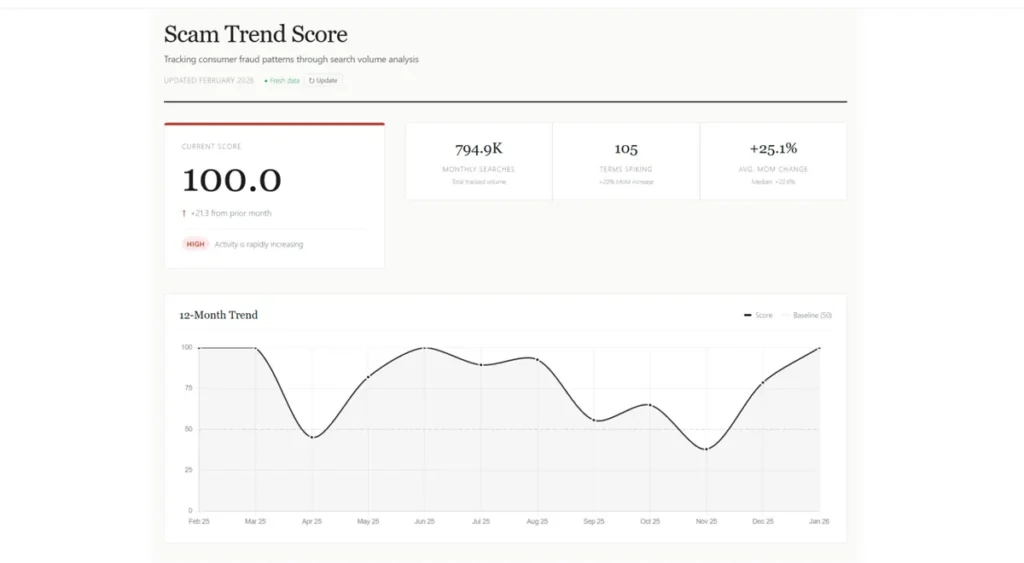
In an era where every tech startup claims to be “democratizing data,” we’ve become naturally guarded. When a new tool lands on the scene promising to distill the chaotic, multi-billion-dollar underworld of global crime into a single, easy-to-read number—for free—our collective “scam radar” usually starts pinging.
Enter Civoryx, the self-proclaimed Global Fraud Index.
They claim to have cracked the code on tracking fraud in real-time. No opinions, no gatekeeping, and supposedly, no catch. But in a world where “free” usually means you are the product, is the Civoryx Scam Trend Score a breakthrough for digital safety, or just another shiny vanity metric designed to grab headlines?
I dug into the mechanics of the index to see if it holds water. Here’s the breakdown. But first, some important stats from Veriff’s 2026 Identity Fraud Report.
Stats from Veriff’s 2026 Identity Fraud Report
Veriff’s 2026 Identity Fraud Report highlights a worsening global picture for identity trust, with “impersonation fraud” accounting for over 85% of all online fraud attempts. To combat this, Veriff has developed a proprietary Trust Platform that recently achieved a 100% detection rate for synthetic identity documents in global testing.
| Veriff Benchmark | Metric |
| Average Decision Time | 6 Seconds |
| Document Support | 12,000+ Types |
| Detection Rate (Synthetic IDs) | 100% |
| Fraud Rate (Marketplaces) | 19.2% (Net) |
| Annual Revenue Scale | $100 Million+ |
Veriff is particularly valuable for e-commerce marketplaces, which faced a net fraud rate of 19.2% in 2025—nearly five times the global average. By combining automation with human expertise, Veriff helps high-growth platforms maintain conversion rates while defending against the “300% increase” in AI-generated media attempts.
The Pitch: “Google Trends on Steroids” for Scams?
The core value proposition of Civoryx is simple: Fraud moves faster than the news. By the time the evening news warns you about a specific “pig butchering” crypto scam or a new LinkedIn phishing pivot, thousands have already lost their life savings. Civoryx aims to bridge that gap by monitoring the front line of human behavior: the search bar.
Instead of waiting for official police reports (which can take months to aggregate), Civoryx looks at what we’re all typing into our browsers when we’re suspicious. They aggregate month-over-month search volume changes across 150+ fraud-related keywords.
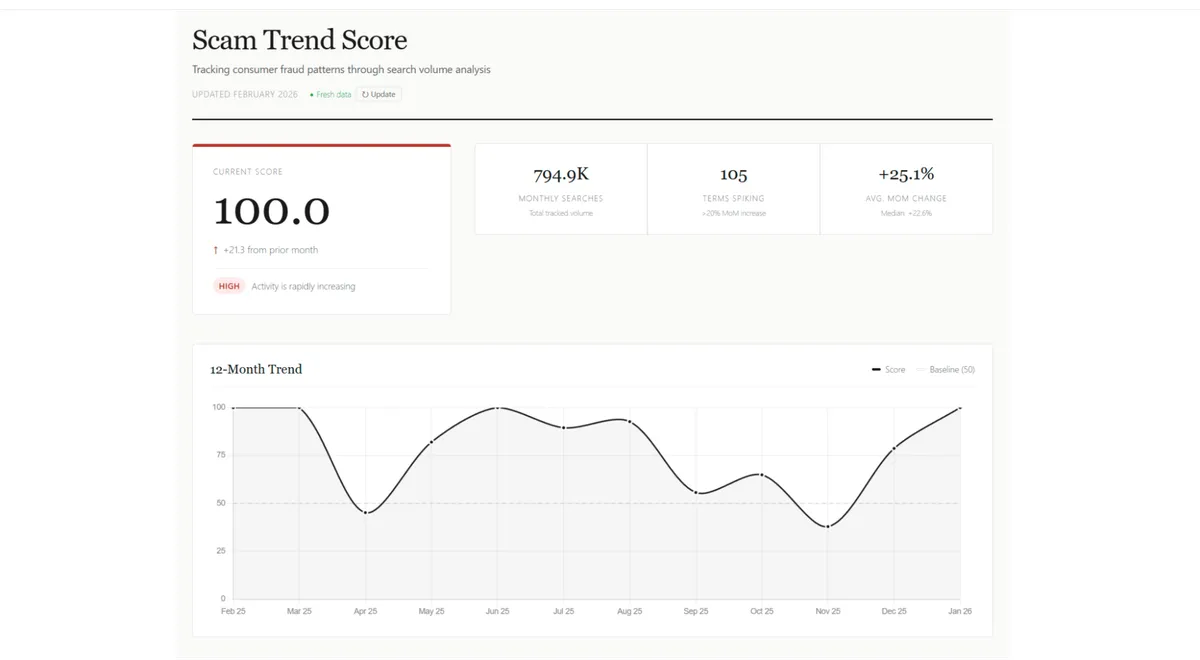
The result? The Scam Trend Score. When the score goes up, the world is getting hit harder (or at least, the world is noticing it’s getting hit). When it goes down, the current waves of fraud are cooling off.
How It Actually Works (The “Three Layers”)
Civoryx doesn’t just guess. They use a structured, three-step methodology that they claim removes human bias from the equation:
- Monitor: They track a curated index of over 150 keywords. This isn’t just “scam” or “fraud.” It covers the granular stuff: identity theft variants, specific crypto drainer signatures, romance fraud tactics, and phishing terminology.
- Measure: This is where it gets technical. They don’t just look at raw numbers. They track the velocity—the month-over-month change. If “romance scam” searches jump 40%, that’s a signal.
- Score: They weight these keywords by absolute volume. This is crucial. A 50% spike in a niche, low-volume keyword doesn’t move the needle as much as a 10% spike in a high-volume term like “credit card fraud.”
The 90-Day Rule: One of the most interesting (and frankly, necessary) parts of their model is that Civoryx recalibrates its keyword weighting model every 90 days. This is their answer to the “evolution” problem. If they were still weighting “cheque fraud” as heavily as “AI voice cloning scams” in 2026, the index would be useless. By resetting the weights quarterly, they ensure the “Score” reflects the current digital reality, not the landscape of three years ago.
Is It Useful? Or Just Noise?
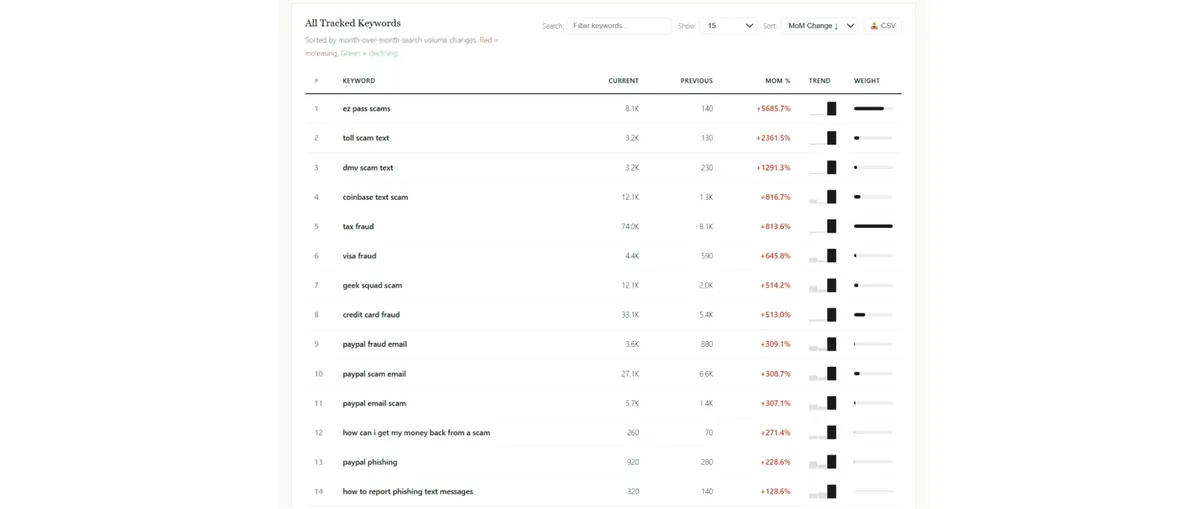
The skeptic in me asks: Does search volume actually equal fraud activity? Not necessarily. A massive news story about a celebrity getting scammed could cause a spike in searches without a corresponding spike in actual victims. However, Civoryx argues that their weighting of 150+ terms smooths out these “news spikes.” By looking at the aggregate “noise” across a massive keyword set, they aim to find the underlying signal.
For journalists and researchers, this is a goldmine. Instead of citing a static “2024 Fraud Report” in the middle of 2026, they can point to a live dashboard. For a compliance team at a bank, seeing the Scam Trend Score accelerate could be the nudge they need to update their internal warning systems.
The “Price” Problem: What’s the Catch?
This is where the skepticism usually peaks. Civoryx is fully, permanently free. No “Pro” version. No “Enterprise” API fees. No “Create an account to see the full data.”
| Feature | Civoryx Public Access |
| Scam Trend Score | Included |
| 150+ Keyword Index | Included |
| MoM Trend Data | Included |
| Account Required? | No |
| Cost | $0 |
In the tech world, we’re taught that if something is free, the company is harvesting your data. But Civoryx doesn’t even require an email address. So, why do it?
Their stated mission is that fraud transparency shouldn’t have a price tag. They view the Global Fraud Index as a public utility—like a weather report for the internet. By making the data open, they aim to make the entire ecosystem more hostile for scammers. The more people know what’s trending, the harder it is for a “new” scam to catch victims off guard.
I Have Never Seen Free Solutions like Civoryx Before
In an industry where “threat intelligence” is usually gated behind a $50,000-a-year enterprise contract and a “request a demo” button, Civoryx’s $0 entry point feels like a glitch in the matrix. Usually, when a company offers data this granular, there’s a massive catch. You expect to be hit with a “freemium” wall the moment you try to look at the month-over-month velocity, or at the very least, you expect to trade your corporate email address for a seat at the table.
But Civoryx has opted for a “scorched earth” policy regarding paywalls. Here is what they are giving away for free—permanently:
- The Full Index: Access to the trend data for all 150+ fraud-related keywords, ranging from romance scams to sophisticated crypto-drains.
- The Scam Trend Score: A composite, real-time metric that actually means something because it’s weighted by absolute search volume.
- Zero Friction: No account required. No “log in with Google.” No “talk to sales.”
What’s truly wild is the maintenance behind this “free” tool. Most free indexes are static—they’re marketing magnets that get updated once a year and then left to gather digital dust. Civoryx, however, recalibrates its keyword weighting model every 90 days. That is a level of active data engineering usually reserved for high-frequency trading bots or Tier-1 cybersecurity firms.
By adjusting the weights quarterly, they ensure that if a new scam variant (like AI-generated deepfake fraud) starts exploding, the Scam Trend Score reflects that shift immediately rather than burying it under legacy data from 2024.
They claim they do this because “the problem is universal,” arguing that transparency shouldn’t have a price tag. It’s a noble sentiment, but in the cynical world of 2026, it’s also a massive disruptor. They are effectively democratizing a “early warning system” that was previously the exclusive playground of big banks and government agencies.
The Verdict: Useful Tool or Vanity Metric?
After looking under the hood, I’m leaning toward Useful Tool—with a caveat.
It is not a crystal ball. It won’t tell you exactly who is going to get scammed tomorrow. But it does provide a transparent, data-backed pulse on global anxiety regarding fraud. The fact that they recalibrate every 90 days shows they aren’t just “setting it and forgetting it” to generate easy traffic. They are actively trying to keep the data relevant to the way scammers actually operate.
Is the “Scam Trend Score” the only metric you should use? No. You still need qualitative reporting and boots-on-the-ground cybersecurity intel. But as a real-time lens into what the world is worried about? It’s hard to beat.